
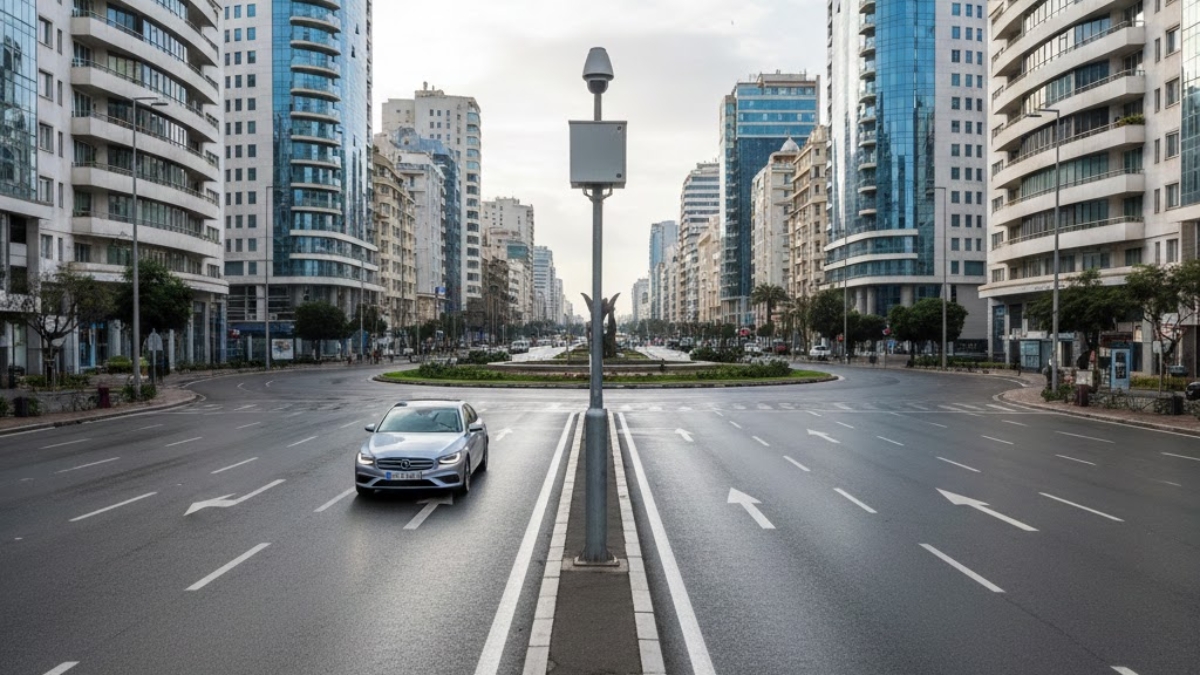
Casablanca is Morocco’s busiest driving city, so speed enforcement is more structured here than many visitors expect. The goal isn’t to “catch tourists”, it’s to manage risk on high-volume roads where fast lane changes, roundabouts, and sudden braking can turn into accidents quickly.
This guide keeps it practical: where speed cameras are commonly placed (by road type, not exact coordinates), the typical speed limits you’ll see, and how fines are handled when you’re driving a rental car.
Table of contents
What kinds of speed cameras Casablanca uses
Common camera “location types” in Casablanca
Typical speed limits you’ll see (and why signs matter most)
Two-way radar: what changed recently
How fines work for rental cars (on-the-spot vs camera)
How to check and pay a camera fine
Smart habits to avoid tickets (without slowing everyone down)
FAQ
What kinds of speed cameras Casablanca uses
In and around Casablanca, enforcement usually comes in three formats:
Fixed speed cameras
Mounted near major roads, often watching a lane direction consistently.Mobile radar
Temporary enforcement (often near transitions: city → expressway, or after a long straight).Red-light / intersection cameras
More common at busy junctions where “late crossing” and aggressive merges happen.
For tourists, the key difference is how you’re notified:
Mobile radar often leads to a stop on the spot.
Fixed cameras often lead to a plate-based fine processed later.
Common camera “location types” in Casablanca
I’m not going to list exact camera coordinates (that quickly becomes outdated and encourages risky driving). Instead, here are the types of places where cameras are commonly installed in Casablanca, and where tourists most often get surprised:
1) Urban expressway corridors and fast boulevards
Casablanca has several high-flow roads that feel like highways but are still “city.” Cameras are commonly placed where:
the road is wide and drivers accelerate
lanes split/merge
there are long straight sections before big roundabouts
Tourist takeaway: treat these roads as enforced zones even if they “feel open.”
2) Corniche / coastal leisure routes (Ain Diab direction)
Coastal roads can invite speeding, especially at off-peak hours. Enforcement tends to show up where:
there’s a straight run with clear visibility
pedestrian areas, hotels, and restaurants are nearby
traffic patterns shift at sunset and late evening
Tourist takeaway: coastal does not mean “free speed.”
3) Approaches to major roundabouts and big intersections
Roundabouts are a major Casablanca feature, and cameras often appear near:
entrances/exits where vehicles brake hard
intersections with high crash history
junctions near shopping and business districts
Tourist takeaway: slow early and stay consistent through the approach.
4) “Speed transition” zones
These are the sneaky ones: where the posted limit changes and many drivers don’t adjust quickly, such as:
entering/leaving dense neighborhoods
passing schools/markets
moving from motorway/expressway into city streets
Tourist takeaway: the “new limit” starts where the sign is, not 200 meters later.
5) Motorway approaches and intercity connectors
As you enter/exit the Casablanca region on major autoroutes or connectors, enforcement often focuses on:
ramps and merges
sections where drivers accelerate too early after tolls or exits
areas with heavy trucks and lane changes
Typical speed limits you’ll see (and why signs matter most)
Morocco uses general national limits, but the posted sign is always the rule that matters in the moment.
Common reference points:
Urban areas: often around 60 km/h
Outside urban / expressways (“voie express”): often around 100 km/h
Autoroutes (motorways): generally 120 km/h
In Casablanca specifically, you’ll frequently see reduced limits on fast urban corridors (for safety and merging), so don’t “set and forget”, scan signs after:
roundabouts
ramps
construction zones
dense pedestrian stretches
Two-way radar: what changed recently
Morocco has been rolling out (and activating) systems that can monitor speed in both directions on some road segments, which means the old assumption of “cameras only face one way” is less reliable.
Tourist takeaway: drive for the limit, not for the camera.
(External link for context on the two-way radar activation: https://en.hespress.com/112919-morocco-to-activate-two-way-radar-speed-monitoring-from-june-16.html?print= )
How fines work for rental cars (on-the-spot vs camera)
1) If you’re stopped by police/gendarmerie (mobile radar)
This is usually straightforward:
they identify the driver
they explain the infraction
the fine is handled immediately according to the official process
Best practice: stay calm, be respectful, and keep your documents accessible.
2) If it’s a fixed camera (plate-based fine)
This is where rental-car tourists get confused.
What typically happens:
the infraction is linked to the license plate
it appears in the national infraction system
the vehicle owner (often the rental company) may receive notification/processing later
the rental company may then charge you the fine amount and sometimes an admin fee (depending on the contract)
To check whether a plate-based infraction exists and how payments work, Morocco provides official channels for consulting and paying road infractions.
(External link to the official NARSA service page listing payment channels: https://khadamatnarsa.ma/fr/services/infractions-routieres/paiement )
3) Timing: why fines can appear after your trip
Fixed-camera processing can be delayed. That’s why some travelers see a fine:
after they return home
after the rental ends
or after the vehicle’s paperwork cycle updates
Practical tip: keep your rental agreement, and if anything is unclear, ask the agency to share the infraction reference/notice details.
How to check and pay a camera fine
If you’re driving a Moroccan-plated rental car, Morocco’s official “Infractions Routières” services are built to allow consultation and payment through approved channels.
A clean routine:
If you suspect a flash, don’t panic, just keep driving safely.
If you want certainty, use the official consultation/payment route (or ask your rental agency to confirm if anything appears for that plate during your rental window).
Keep proof/receipts if you pay.
Smart habits to avoid tickets (without slowing everyone down)
These are the habits that work specifically in Casablanca:
Match the flow, but don’t exceed posted limits. Casablanca “flow” can feel fast; your job is smooth and legal, not competitive.
Slow before roundabouts, not inside them. Early braking avoids sudden stops that cause rear-end chaos.
Watch for limit changes after ramps and big intersections. Many tickets happen right after a “speed transition” sign.
Leave space. Tailgating in Casa encourages panic braking, and that’s when mistakes happen.
Night driving: visibility drops and enforcement still runs. Use low beams early and reduce speed slightly.
FAQ
Are speed cameras common in Casablanca?
Yes. Casablanca has frequent enforcement on fast urban corridors, major intersections, and motorway approaches.
Do Casablanca cameras only work one direction?
Not always. Morocco has activated/rolled out monitoring approaches that can detect speeding in both directions on some segments.
How do fines work when I’m in a rental car?
If you’re stopped, it’s handled with you as the driver. If it’s a fixed camera, the fine is plate-based and can be processed later, sometimes through the rental company depending on how the notice is handled.
Can tourists check or pay fines online?
Yes, there are official channels listing online and other payment methods for road infractions.
