
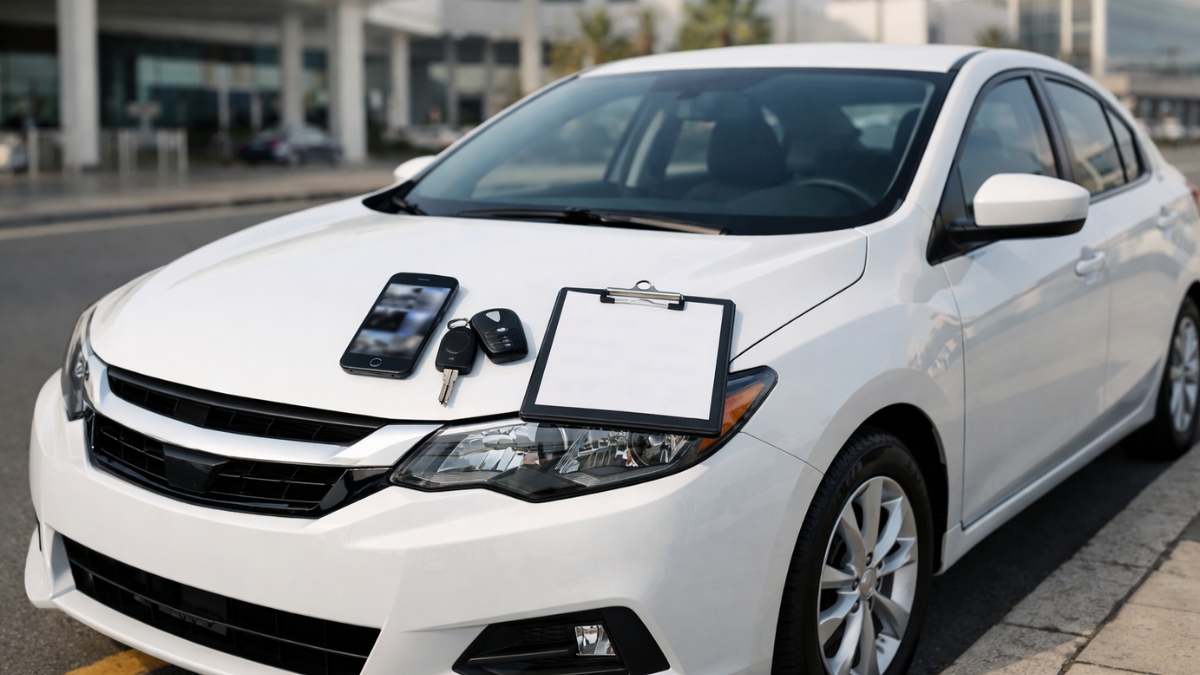
A smooth rental in Casablanca isn’t only about booking, it’s about proof. Most disputes happen for boring reasons: a small scratch that was already there, a scuffed wheel you didn’t notice, or a missing accessory nobody mentioned at pickup. The fix is simple: take the right photos, in the right order, with the right details.
This guide gives you a practical, 10–12 minute inspection routine you can do at Casablanca airport pickup, a hotel delivery, or a downtown handover, without turning it into a stressful “car exam.” If you follow this checklist, you’ll have clear documentation that makes disagreements rare and easy to resolve.
Table of contents
The 2 rules that make your photos “dispute-proof”
Before you shoot: set up your phone in 20 seconds
The 12-minute walkaround photo checklist
Inside-cabin photo checklist (the stuff people forget)
Quick functional checks (no mechanic skills needed)
What to write on the handover sheet (and why)
How to send your proof so it actually counts
Return-day mini-checklist (to avoid last-minute surprises)
1. The 2 rules that make your photos “dispute-proof”
Rule 1: Shoot wide first, then close.
Start with wide angles that show the whole side of the car and the surroundings (lighting, location), then zoom into details like scratches, wheels, and windshield chips. Wide shots prove context; close-ups prove condition.
Rule 2: Include “identity” shots.
If your photos can’t be tied to that exact car, they’re weaker. Always capture:
The license plate
The VIN (vehicle identification number)
The odometer and fuel level
If you use an iPhone, you can view the date/time details (metadata) of each photo inside the Photos app, useful if you ever need to prove when the pictures were taken:
See: Apple’s guide to viewing photo information on iPhone
2. Before you shoot: set up your phone in 20 seconds
Do these quick tweaks before you start:
Turn off “beauty” filters or smoothing modes (they hide fine scratches).
Set video to 1080p (good quality without huge file sizes).
Tap to focus on the car surface when shooting close-ups.
If it’s dark, use flashlight for close shots, especially wheels and bumpers.
If the car is in shade, try to get at least one set of photos in strong, even light (move the car a meter if needed, or change your angle).
3. The 12-minute walkaround photo checklist
Think of the exterior inspection as four “chapters”: identity, wide proof, damage zones, and details.
A) Identity shots (1 minute)
Front license plate (straight-on)
Rear license plate (straight-on)
VIN plate (often visible at the base of the windshield on the driver side, or inside the door frame)
Odometer + fuel gauge (dashboard photo with ignition on)
Tip: Take these first. If someone rushes you, at least you have the essentials.
B) Wide shots (2 minutes)
Front 3/4 angle (shows hood, bumper, one side)
Rear 3/4 angle
Full left side (standing back so the whole side fits)
Full right side
Straight front (headlights + bumper)
Straight rear (trunk + bumper)
These are your “baseline” images. If a dispute happens, wide shots make it easy to show that damage was already present.
C) High-risk zones (6 minutes)
These areas cause most claims, photograph them carefully.
Front bumper corners (left and right)
Lower lip under the bumper (scrapes from ramps are common)
Hood (stone chips and dents)
Windshield (shoot at an angle to reveal chips)
Side mirrors (outer casing + glass)
Door edges (open each door and photograph the edge)
Rocker panels / side skirts (low scratches)
Rear bumper corners
Trunk lip (loading scratches)
For each scratch you see, do a quick 2-photo combo:
One medium shot showing where it is
One close-up showing what it is
D) Wheels, tires, and rims (3 minutes)
Each wheel/rim close-up (4 photos total)
Each tire sidewall (cuts/bulges)
Tread depth look (a simple close-up of tread)
Why so many rim photos? Because “curb rash” is one of the most common arguments at return, small, easy to miss, and easy to blame.
If you want a quick safety reference on tires and tread basics, this is a solid overview:
NHTSA tire safety information
4. Inside-cabin photo checklist (the stuff people forget)
Open the doors and take quick interior proof:
Driver seat, passenger seat, rear seats (wide shots)
Dashboard (with ignition on if possible)
Center console (gear area, buttons, screens)
Roof lining (stains happen)
Trunk empty (important, proves no missing cover/tools due to you)
Then capture accessories clearly:
Key fob(s) and any spare key
Warning triangle, jack, spare tire (if accessible)
Child seat (if provided), including its condition and straps
If something is missing, photograph the empty space where it should be (for example: “no spare tire compartment content”).
5. Quick functional checks (no mechanic skills needed)
You don’t need to be a car expert, just test what affects safety and “return condition” claims.
In 2–3 minutes:
Headlights + brake lights + indicators (you can film while walking around)
Wipers + washer fluid spray (quick check)
Horn (short tap)
Air conditioning (turn on, confirm it blows)
Windows (up/down once)
If a warning light is on, photograph the dashboard clearly and point it out immediately.
6. What to write on the handover sheet (and why)
If you get a condition form, don’t sign it “clean” if it’s not clean.
Write short, specific notes like:
“Scratch front bumper right corner”
“Rim scuff front left”
“Chip windshield passenger side”
“Fuel: 6/8” or “Fuel: 3/4”
If they prefer diagrams, mark the general area and back it up with your photos.
7. How to send your proof so it actually counts
Photos help most when the rental company receives them while you’re still at pickup.
Do this:
Send a single message with 6–10 key photos (plates, VIN, odometer, wide sides, biggest damage)
Add: “Photos taken at pickup, please confirm noted.”
Keep the rest saved in an album on your phone.
If there’s time pressure, prioritize: plates + VIN + odometer + wide sides + any visible damage.
8. Return-day mini-checklist (to avoid last-minute surprises)
Before you hand back the keys:
Repeat 4 wide exterior shots (front, rear, left, right)
Photograph the rims again (especially if you parked near curbs)
Photo of the fuel gauge
10-second video sweep of the car
Photo of the agent receiving keys (hands only, no faces) or a signed receipt if provided
This “closing proof” prevents the classic problem: everything was fine, then a claim appears hours later.
